OMEGA ENGINEERING LCK-500 Subminiature Compression Cell
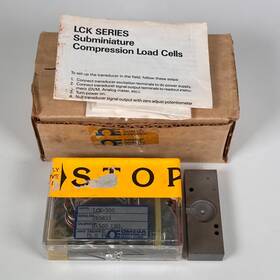
( Brand: Omega Engineering ), ( Manufacturer Part Number: LCK-500 ), ( Model: OMEGA ENGINEERING LCK-500 ), ( Part Type: Compression Cell )
Review OMEGA ENGINEERING Subminiature Compression Load Cell
The **Omega Engineering LCK-500 Subminiature Compression Cell** is a precision-engineered, high-performance load cell designed for applications requiring compact size without compromising accuracy or durability. This subminiature compression cell is ideal for integrating into tight spaces where traditional load cells would be impractical, making it a versatile choice for research, industrial testing, and custom instrumentation. Constructed from high-grade stainless steel and featuring a robust, hermetically sealed design, the LCK-500 ensures long-term reliability in demanding environments, including those exposed to moisture, dust, or corrosive substances. With a capacity range of up to 500 pounds (222 kg), it delivers exceptional linearity and hysteresis performance, ensuring consistent and repeatable measurements with minimal drift over time. The cell s compact form factor measuring just 0.75 inches in diameter and 1.5 inches in length allows for seamless integration into OEM equipment, test stands, or portable measurement systems without sacrificing structural integrity. Its low-profile design also minimizes interference with surrounding components, making it particularly well-suited for applications in aerospace, medical devices, automotive testing, and precision engineering. The LCK-500 operates on a strain gauge-based sensing mechanism, providing high-resolution output signals that can be easily interfaced with data acquisition systems, digital indicators, or control algorithms. Whether used for material testing, force feedback systems, or dynamic load monitoring, this load cell combines precision engineering with unmatched compactness, making it an indispensable tool for engineers and researchers seeking reliable force measurement in confined spaces.
### Pros and Cons of buying a Omega Engineering LCK-500 Subminiature Compression Cell
#### **Pros:**1. **Precision and Accuracy** The LCK-500 is designed for high-precision measurements, making it ideal for applications requiring accurate force or load data. Its subminiature size allows for precise testing of small components without compromising performance.
2. **Compact and Versatile Design** As a subminiature cell, it is well-suited for applications where space is limited, such as in medical devices, aerospace components, or small-scale industrial testing. Its small footprint does not hinder its ability to deliver reliable readings.
3. **Wide Measurement Range** The LCK-500 typically offers a broad range of measurable forces (often from a few grams to several hundred pounds, depending on the model variant), making it adaptable to various testing scenarios.
4. **Durability and Reliability** Omega Engineering is known for producing high-quality, durable instrumentation. The LCK-500 is built to withstand repeated use in demanding environments, ensuring long-term performance.
5. **Compatibility with Data Acquisition Systems** It is designed to integrate seamlessly with data acquisition systems, allowing users to log and analyze force data efficiently. This is particularly useful in research, quality control, and manufacturing processes.
6. **Low Profile and Minimal Intrusion** Its subminiature size means it can be mounted directly onto test specimens or fixtures without significantly altering the structural integrity of the sample being tested.
7. **Calibration and Traceability** Omega s products often come with calibration certificates, ensuring traceability to national standards, which is crucial for industries like aerospace, automotive, and medical device testing.
8. **Easy Installation and Maintenance** The design is straightforward, making it relatively easy to install and maintain. Replacement or recalibration is typically simple compared to larger, more complex load cells.
---
#### **Cons:**1. **Limited Force Capacity for Heavy-Duty Applications** While the LCK-500 is excellent for small-scale testing, it may not be suitable for applications requiring high-force measurements (e.g., heavy machinery testing or large structural components). Users may need to pair it with an amplifier or adapter for optimal performance in such cases.
2. **Potential Sensitivity to Environmental Factors** Like many precision instruments, the LCK-500 can be affected by temperature fluctuations, humidity, or electrical noise. Proper shielding and calibration may be necessary to ensure consistent readings in variable environments.
3. **Cost Relative to Capacity** For applications where larger load cells would suffice, the LCK-500 may represent a higher cost per unit of force capacity. Users must weigh the need for precision against the investment required.
4. **Limited Overload Protection** Subminiature cells often have less inherent overload protection compared to larger load cells. Exceeding the rated capacity can damage the sensor, so careful handling and proper safeguards are essential.
5. **Signal Conditioning Requirements** While the LCK-500 is designed for ease of use, it may still require an external amplifier or signal conditioner to interface with data acquisition systems. This adds to the overall system complexity and cost.
6. **Wear and Tear Over Time** Due to its small size, the internal components may be more susceptible to wear from repeated cycling or harsh conditions. Regular maintenance and recalibration are recommended to sustain accuracy.
7. **Compatibility Issues with Some Fixtures** The compact design may not fit seamlessly with all existing test fixtures or mounting systems. Custom adapters or modifications might be necessary, adding to the setup time and cost.
8. **Limited Customization Options** Omega s standard LCK-500 models may not offer extensive customization for specific niche applications. Users with highly specialized needs may need to explore alternative solutions or modifications.
---
### **Conclusion:**The Omega Engineering LCK-500 Subminiature Compression Cell is an excellent choice for applications requiring high-precision force measurements in confined spaces. Its compact design, accuracy, and compatibility with data acquisition systems make it ideal for medical device testing, aerospace components, small-scale industrial applications, and research environments where space and precision are critical. However, its limitations in terms of force capacity, sensitivity to environmental factors, and potential compatibility issues with certain fixtures must be carefully considered. For users working with heavy loads or in environments with extreme conditions, additional safeguards or complementary equipment may be necessary.
### **Recommendation:**If your application involves testing small components, requires high precision, and operates within the force range of the LCK-500 (typically up to a few hundred pounds), this load cell is a strong recommendation. Ensure that your testing environment is controlled to minimize temperature and electrical interference, and consider investing in a compatible amplifier or signal conditioner if needed. For applications demanding higher force capacities or greater durability, explore larger load cells or alternative models from Omega or other manufacturers. Always verify the specific model variant s specifications to confirm it meets your exact requirements before purchasing.
Details:
Please look at all photos before purchasing. This item was pulled from a working environment. Only items included in pictures are the sale. Tested and Working.
part #: lck500 price
- $179.99
specifications generapneumati:
- brand: Omega Engineering
- mpn: Lck-500
- model: Omega Engineering Lck-500
- part type: Compression Cell
payments generapneumati:
- other
- credit card: Mastercard
- wallet: Google-pay
offer generapneumati:
- options: Ship-to-home
- started: February 18, 2026
- availability: In Stock
- best offers: True
- sold: 0
- quantity: 1
shipping generapneumati:
- carrier: UPS
- class: Standard
- service: UPS Ground
- type: Fixed
- cost: $9.99
- transit: 3-7 Days
general generapneumati:
- Business Industrial > Hydraulics, Pneumatics, Pumps Plumbing > Other Hydraulics Pneumatics
- condition: Used
returns generapneumati:
- method: Money back
- policy: Returns Accepted
- time: 30 Days
- paid by: Seller
seller generapneumati:
- rating: 99.3%
- # reviews: 11324
- city: San Diego, California
Omega Engineering LCK-500 Is Similar To:
- Hhp-2022 Omega Engineering Pressure Meter (45.5% similar) Expedited shipping can be arranged upon request. Local pick-up is available...(July 10th, 2018)
- Pgt-60l-1000s Omega Engineering Inc 0-1000 (43.1% similar) Reclamation station offerings...(September 26th, 2017)
- Omega Engineering Fma-1609a-lss Fma-1609a Mass And Volumetric Flow Meter (42.4% similar) Volumetric flow, mass or absolute pressure, and temperature can be viewed recorded through the RS232 connection. Still in great condition. A laminar flow element FD inside the meter forces gas into streamlined. Used Omega mass flow meter, max flow 50SLM. These flow meters are also available in a ...(September 17th, 2024)
- Omega Engineering Ps-4g Ps4g Used (46.3% similar) Packaging and handling: items are safely eds packaged in custom shipping cartons for protection. Call to use a shipping service other than the ones listed. All products are guaranteed to be working but may show signs of use if purchasing a used product. Sells new and surplus product develops ...(January 10th, 2026)
- Omega Engineering Px410-500si Px410500si Used (50.5% similar) Packaging and handling: items are safely eds packaged in custom shipping cartons for protection. All products are guaranteed to be working but may show signs of use if purchasing a used product. Sells new and surplus product develops channels to purchase such. Call to use a shipping service other ...(February 5th, 2026)
- Omega Engineering Flsc-61 Direct Mount Signal Conditioner (53% similar) Serial number - 292905. Omega Engineering direct mount signal conditioner. Item is untested. Model number - FLSC-61. Item is sold as...(February 16th, 2026)
- Omega Engineering Px219-030gi Px219030gi Used (48.6% similar) All products are guaranteed to be working but may show signs of use if purchasing a used product. Call to use a shipping service other than the ones listed. Sells new and surplus product develops channels to purchase such. Packaging and handling: items are safely eds packaged in custom shipping ...(February 17th, 2026)
- Omega Engineering Px303-100a5v Stainless Steel Pressure Transducer Px309-2kg5v (46.4% similar) Item is sold as. Stainless steel pressure transducer. Omega Engineering...(February 24th, 2026)
- Omega Engineering Ip511-060 Ip511060 Used (50.5% similar) Packaging and handling: items are safely eds packaged in custom shipping cartons for protection. Sells new and surplus product develops channels to purchase such. Call to use a shipping service other than the ones listed. All products are guaranteed to be working but may show signs of use if ...(March 10th, 2026)
