AIR GAGE COMPANY AEC-247 Pneumatic Device Usip
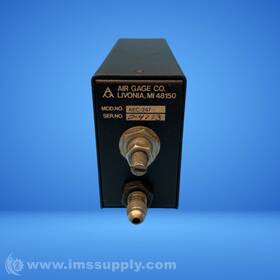
( Brand: Air Gage Company ), ( Manufacturer Part Number: AEC-247 ), ( Part Type: Pneumatic Device )
Review AIR GAGE COMPANY Pneumatic Device Usip
The **AEC-247 Pneumatic Air Gage** is a precision-engineered, high-performance measurement device designed for industrial applications requiring accurate, repeatable, and contact-free dimensional inspections. Part of the advanced **Air-Electric Control (AEC)** series, this air-operated gage leverages pneumatic technology to deliver unmatched reliability, durability, and versatility in environments where traditional mechanical gauges may fall short. Built with a robust stainless steel housing and sealed pneumatic components, the AEC-247 is engineered to withstand harsh conditions, including exposure to dust, moisture, and temperature fluctuations, making it ideal for manufacturing, quality control, and production line applications in sectors such as aerospace, automotive, machinery, and general engineering. Its compact yet sturdy design ensures easy integration into automated systems, CNC setups, or manual inspection workflows, while its modular construction allows for quick adjustments and customization to accommodate a wide range of part geometries and measurement ranges.
At the heart of the AEC-247 lies its **pneumatic sensing mechanism**, which operates by comparing the air pressure required to displace a calibrated piston against a reference standard. When the gage s probe tip makes contact with the workpiece, it generates a proportional air signal that is transmitted to an external indicator or control system, providing real-time feedback on dimensional accuracy. This contactless measurement principle eliminates wear and tear on both the gage and the part being inspected, reducing downtime and ensuring long-term precision. The device features a **highly sensitive air valve system** that delivers exceptional resolution, typically within ** 0.0001 inches (0.0025 mm)**, depending on the calibration and setup, making it suitable for critical applications where even minute deviations can impact performance or safety. Additionally, its **adjustable air supply pressure** allows operators to fine-tune sensitivity and response time, catering to different material hardnesses and surface finishes without compromising accuracy.
The AEC-247 is equipped with a **quick-connect air fitting** and a **durable, replaceable probe tip** designed to minimize maintenance while maximizing longevity. The probe tip, available in various materials such as hardened steel, carbide, or ceramic, can be easily swapped to adapt to different surface conditions, from soft metals to abrasive composites. The gage s **sealed pneumatic lines and filters** prevent contamination from entering the system, further enhancing its reliability in dirty or unregulated environments. For enhanced usability, the AEC-247 often pairs with **digital readout systems** or **programmable logic controllers (PLCs)**, enabling seamless integration into automated inspection stations where data logging, trend analysis, and process control are essential. Its **low-power operation** and compatibility with standard compressed air systems (typically 20 100 PSI) make it energy-efficient and cost-effective to operate, reducing overhead while maintaining high standards of precision.
Beyond its technical capabilities, the AEC-247 is designed with **ergonomic and practical considerations** in mind. Its **lightweight yet sturdy construction** allows for easy handling, while the **clear labeling and intuitive controls** simplify setup and operation. The gage s **modular design** also supports the addition of accessories such as **adapters, extensions, or specialized probes**, expanding its functionality for complex measurements or hard-to-reach areas. Whether used for inspecting cylindrical components, flat surfaces, or intricate contours, the AEC-247 delivers consistent, high-precision results with minimal operator intervention. Its **calibration stability** and **long-term accuracy** make it a trusted tool for quality assurance teams, ensuring that every measurement meets or exceeds industry standards. By combining the robustness of pneumatic technology with the precision of air-based measurement, the AEC-247 stands as a reliable workhorse in modern manufacturing, bridging the gap between manual inspection and automated quality control with ease.
**Pros and Cons of buying a Air Gage AEC-247 Pneumatic Device**
The **Air Gage AEC-247** is a pneumatic air gage designed for precision measurement in industrial applications, particularly for checking diameters, thicknesses, and other dimensional features. Below is a detailed analysis of its advantages and disadvantages.
---
### **Pros**
1. **High Precision and Accuracy**
The AEC-247 is engineered for tight tolerances, making it suitable for applications requiring micrometer-level measurements. Its pneumatic design minimizes mechanical wear and drift, ensuring consistent readings over time.
2. **Durability and Reliability**
As a pneumatic device, it lacks moving electrical components, reducing the risk of electrical failure or calibration drift. The robust construction is designed for harsh industrial environments, including exposure to dust, moisture, and temperature fluctuations.
3. **Fast and Non-Contact Measurement**
Unlike mechanical gauges, the AEC-247 operates without physical contact with the workpiece, reducing wear on both the gauge and the part being measured. This also allows for quicker inspections, especially in automated or high-volume production lines.
4. **Compatibility with Automation**
The pneumatic output can be easily integrated into automated systems, CNC machines, or robotic arms. It can trigger signals for pass/fail decisions in real-time, improving efficiency in quality control processes.
5. **Low Maintenance Requirements**
Since it relies on compressed air rather than electrical or mechanical components, maintenance is simplified. There are no seals, bearings, or sensors that degrade over time, reducing downtime and repair costs.
6. **Versatility in Applications**
The AEC-247 can be adapted for various measurement tasks, including internal and external diameter checks, wall thickness measurements, and gap assessments. Its modular design allows for interchangeable probes and adapters.
7. **Consistent Calibration Stability**
Pneumatic gauges are less affected by temperature variations compared to some electronic or mechanical alternatives. This stability ensures that calibration remains accurate over extended periods without frequent recalibration.
8. **Safety in Hazardous Environments**
Because it operates on compressed air, it poses no electrical hazards, making it suitable for use in explosive or flammable environments where spark risks must be avoided.
9. **Cost-Effective for High-Volume Use**
While the initial purchase price may be higher than some basic mechanical gauges, its longevity and low maintenance costs make it cost-effective for large-scale manufacturing operations.
10. **Easy Integration with Existing Systems**
Many pneumatic gauges, including the AEC-247, can be retrofitted into existing production lines with minimal modifications. This reduces the need for extensive system overhauls.
---
### **Cons**
1. **Higher Initial Cost**
Compared to basic mechanical or digital gauges, the AEC-247 represents a significant upfront investment. Small businesses or low-volume operations may find this cost prohibitive.
2. **Dependence on Compressed Air Supply**
The device requires a stable and clean source of compressed air. Poor-quality air (with moisture, oil, or contaminants) can affect measurement accuracy and shorten the lifespan of internal components. Additional filtration and drying systems may be necessary, adding to operational costs.
3. **Limited Portability**
Due to its pneumatic and potentially complex setup, the AEC-247 is not as portable as handheld digital calipers or micrometers. It is best suited for stationary use in a controlled environment.
4. **Learning Curve for Operation**
Operators may require training to properly calibrate, maintain, and interpret readings from the AEC-247. Misuse or improper setup can lead to inaccurate measurements or equipment damage.
5. **Calibration Complexity**
While pneumatic gauges are stable, they still require periodic calibration to ensure accuracy. This process may be more involved than calibrating a simple mechanical gauge and could require specialized equipment or technicians.
6. **Potential for Air Leaks**
Over time, seals and connections in the pneumatic system can degrade, leading to air leaks. These leaks can cause measurement inconsistencies and increase energy costs if the system is not properly maintained.
7. **Limited Display Options**
The AEC-247 typically relies on external indicators (e.g., gauges, digital readouts, or PLC interfaces) for displaying measurements. Unlike some electronic gauges, it may not have a built-in digital screen, requiring additional instrumentation.
8. **Not Ideal for Very Small or Delicate Parts**
While it excels in precision, the AEC-247 may struggle with extremely small or fragile parts due to the nature of pneumatic measurement (e.g., air flow dynamics). Mechanical or optical gauges might be more appropriate in such cases.
9. **Environmental Sensitivity**
Extreme temperatures, humidity, or pressure fluctuations in the compressed air supply can affect performance. While pneumatic gauges are generally robust, their accuracy is not immune to environmental factors.
10. **Limited Software or Data Logging Features**
Unlike modern digital gauges, the AEC-247 may lack built-in data logging or connectivity to software for trend analysis or quality control reporting. Additional systems may be needed for comprehensive data management.
---
### **Conclusion**
The **Air Gage AEC-247** is a high-performance pneumatic measurement device well-suited for industrial applications requiring precision, durability, and integration with automated systems. Its strengths lie in its accuracy, low maintenance, and reliability in harsh environments. However, its higher cost, dependence on compressed air, and limited portability may make it less ideal for small-scale or low-budget operations.
For businesses engaged in **high-volume manufacturing, quality control, or applications where tight tolerances and automation are critical**, the AEC-247 is an excellent investment. It is particularly advantageous in sectors such as aerospace, automotive, or machinery manufacturing where consistency and efficiency are paramount.
For **small workshops, research labs, or applications requiring frequent manual measurements**, a more portable or lower-cost alternative (e.g., digital calipers, micrometers, or optical gauges) might be more practical.
---
### **Recommendation**
**Buy the Air Gage AEC-247 if:**- You operate in an industrial setting with high-volume production needs.
- Precision and automation are critical to your quality control processes.
- You already have a reliable compressed air system in place.
- Your budget allows for the initial investment, and you can justify the long-term cost savings from reduced maintenance and downtime.
**Avoid the Air Gage AEC-247 if:**- Your operations are small-scale or require frequent manual inspections.
- You lack a stable compressed air supply or cannot invest in air filtration/drying systems.
- You need a portable, low-cost solution for occasional measurements.
- Your applications involve very small, delicate, or irregularly shaped parts.
**Alternative Considerations:**- For **lower-cost, portable measurements**, consider digital calipers or micrometers.
- For **high-precision but non-pneumatic needs**, explore laser or optical gauges.
- If **automation is key but pneumatic systems are impractical**, evaluate electronic gauges with built-in connectivity.
Ultimately, the AEC-247 is a **superior choice for industrial-grade precision measurement**, but its suitability depends on your specific operational requirements and constraints.
Details:
A previously used, fully functional product that may have some signs of cosmetic wear. Most items are in stock when they listed. The product must be the original item shipped, with matching serial numbers if applicable. Air Gage Company AEC-247 Pneumatic Device Manufactured by AIR GAGE COMPANY.
Special Instructions. Manufacturer Part Number: AEC-247. Air Gage Company AEC-247 Pneumatic Device Pneumatic device manufactured by with part number. 2-Year MRO Shield Protection Plan Included.
part #: aec247 prices
- $145.20-$483.56
specifications generapneumati:
- brand: Air Gage Company
- mpn: Aec-247
- part type: Pneumatic Device
shipping generapneumati:
- class: Standard, One-day
- cost: $0.00
- carrier: UPS
- type: Calculated
- service: UPS Ground, UPS Next Day Air
- transit: 5-8 Days
returns generapneumati:
- time: 30 Days
- policy: Returns Accepted
- paid by: Buyer
- method: Money back
offer generapneumati:
- quantity: 1
- best offers: True
- started: May 28, 2026
- options: Ship-to-home
- sold: 0
- availability: In Stock
payments generapneumati:
- credit card: Discover
- wallet: Apple-pay
- other
general generapneumati:
- condition: Used
- Business Industrial > Hydraulics, Pneumatics, Pumps Plumbing > Other Hydraulics Pneumatics
seller generapneumati:
- rating: 99.8%
- # reviews: 26020
- city: Mount Sterling, Kentucky
Air Gage Company AEC-247 Is Similar To:
- 06f11ac Parker 1-4 Pneumatic Air (41% similar) Parker 1/4 pneumatic Air line filter 06F11AC...(February 5th, 2018)
- 07434 Central Pneumatic 3-8 Air (41.6% similar) Box shows shelf wear. Unit 150PSI max nib item 07434NOS in unpin box. Up for sale is a central pneumatic 3/8 Air...(October 3rd, 2017)
- 15sthf30q Cleco 1x Air Pneumatic (33.3% similar) For sale manufacturer Cleo Air pneumatic reversible screwdriver nut setter origin made in Germany part no. 15STHF30Q quantity one 1 condition new dimensions 295MM l x 65MM w 40MMAPPROX...(May 13th, 2017)
- 1717 Astro Pneumatic Deluxe Green Air Blow Gun 745227002955 (34.3% similar) This item is brand-new, factory sealed...(April 17th, 2018)
- 18-232 Unbranded Pneumatic Air Blower Quick Usa Preowned (37.3% similar) The photos are a part of. Immediate purchase is available. Have a great day. Sometimes boxes or packaging will have warranty information printed on it. Ask questions before you bid or use and the offer has ended...(November 14th, 2018)
- 1827as105-1 Oxygen Pneumatic Air Hose Assy Nsn Nos (39.6% similar) Listed for Michael. Its often to late solve them if you wait. Problems are questions that were not asked before the offer closed. Operating pressure: 3000PSITHIS hose assembly is currently priced else ware at approx. 4 burst test pressure: 12,000PSI max. Elector Marvin is a 9-5 Mon-Fri business...(March 7th, 2018)
- 18u1301 Wadoy Central Pneumatic Air Compressor Pressure Switch Control 6950740548031 (32.3% similar) This is non-original parts, replacement for oem. Easy to install and convenient use. It can help to save electric energy of the Air compressor. This is a great switch for miniature Air compressor. Wadi central pneumatic Air compressor pressure switch control valve replacement parts psi 240V features...(October 23rd, 2018)
- 1am-ncc-12 Gast Pneumatic Air Motor (39.5% similar) Part: 1AM-NCC-12 prices...(June 13th, 2018)
- Gast Motor 1up-gr11 15 Pneumatic Series 1 Gear Air Ratio (43.1% similar) Torque 40GEAR ratio 15 1MAX. Pressure rpm in. Technical specs item Air gear motor type rotary vane material cast iron hp. 33RUNNING torque max includes high strength steel output shaft with key and plastic cover, tapered roller bearing and hardened polished steel worm mating with forged, heat ...(June 13th, 2015)
- 23102 Aro Lot Of Corp Model Pneumatic Air Couplers Couplings (39.6% similar) ...(March 16th, 2018)
- 23321312 Prestige Pneumatic Air Die Grinder Rpm Straight Handle (34.9% similar) Exhaust location rear inlet size not condition: new original packaging opened for pictures and inspection includes:items described above exactly whats pictured this item packed ready to ship weighs Air pressure bar pounds...(September 3rd, 2018)
