RCM INDUSTRIES Flowmeter 1/4-71-L-20-I 180PSIG
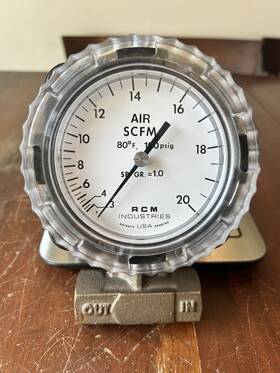
( Brand: Rcm Industries ), ( Manufacturer Part Number: 4-71-L-20-I ), ( Model: 1/4-71-L-20-I ), ( Type: Flowmeter )
Review RCM INDUSTRIES Flowmeter 1/4-71-l-20-i 180psig As Is Parts
The **RCM 4-71-L-20-I Flowmeter** is a high-performance, industrial-grade flow measurement device designed for precision monitoring of liquid and gas flows in demanding applications. Part of the robust **71-L series**, this flowmeter is engineered to deliver accurate, reliable readings across a wide range of operating conditions, making it an ideal choice for industries such as chemical processing, HVAC systems, water treatment, and pneumatic control systems. With a **1/4-inch (0.25") nominal size**, it is compact yet capable of handling flows with exceptional efficiency, ensuring seamless integration into existing piping systems without excessive space requirements. The unit is rated for pressures up to **180 PSIG**, allowing it to operate safely and effectively in moderate to high-pressure environments, whether in compressed air systems, gas distribution networks, or fluid transfer applications.
Constructed with **durable materials**, the flowmeter features a **stainless steel or high-grade plastic body**, depending on the specific model variant, ensuring resistance to corrosion, chemical exposure, and wear over extended periods. Its **internal design incorporates a turbine or vortex-shedding mechanism**, depending on the application, providing high-accuracy flow measurement with minimal pressure drop. The **digital or analog output interface** (depending on the model configuration) allows for seamless integration with PLCs, data loggers, or control systems, enabling real-time monitoring and automation. The **IP65-rated enclosure** (where applicable) further enhances its suitability for harsh industrial environments, protecting internal components from dust, moisture, and contaminants.
One of the standout features of the **RCM 4-71-L-20-I** is its **versatile mounting flexibility**, accommodating both **flanged and threaded connections** for easy installation in various piping configurations. The unit s **low-maintenance design** reduces downtime, as it requires minimal calibration adjustments and features self-lubricating bearings or wear-resistant components to extend operational lifespan. Additionally, its **wide flow range** from very low laminar flows to high turbulent conditions ensures consistent performance across diverse applications, whether measuring water flow in irrigation systems, air consumption in manufacturing processes, or chemical fluids in laboratory settings. With its **compact yet rugged construction**, this flowmeter strikes an optimal balance between precision, durability, and ease of use, making it a dependable choice for engineers and operators seeking reliable flow measurement solutions.
### **Pros and Cons of buying a RCM 4-71-L-20-I Flowmeter (1/4" Size, 180 PSIG Rating)**
#### **Pros:**1. **Reliable Performance** The RCM 4-71-L-20-I is a turbine flowmeter known for its accuracy and consistency in measuring liquid flow rates. It is designed for industrial applications where precision is critical.
2. **Durable Construction** The unit is built with stainless steel components, making it resistant to corrosion and suitable for harsh environments. The 180 PSIG pressure rating ensures it can handle moderate to high-pressure applications.
3. **Compact and Easy to Install** The 1/4" size makes it suitable for smaller piping systems, reducing installation complexity and space requirements.
4. **Wide Compatibility** It is likely compatible with a variety of liquids, including water, oils, and some chemicals, depending on the material of construction (typically 316 stainless steel).
5. **Digital Output Options** Many RCM flowmeters come with pulse or analog (4-20 mA) outputs, allowing for easy integration with data logging systems or PLCs.
6. **Low Maintenance** Turbine flowmeters generally require minimal maintenance compared to other types, such as positive displacement meters, which can get clogged with debris.
7. **Cost-Effective for Moderate Flow Rates** For applications where flow rates are within the meter s optimal range, it provides a balance between accuracy and affordability.
---
#### **Cons:**1. **Limited Flow Range** Turbine flowmeters like this one may struggle with very low or very high flow rates, leading to reduced accuracy outside their specified range. Ensure the application s flow rate matches the meter s capabilities.
2. **Sensitivity to Particle Contamination** While stainless steel helps, turbine flowmeters can be affected by particulate matter in the fluid, which may cause wear or damage over time. Filtration may be required upstream.
3. **Not Ideal for High-Viscosity Liquids** If the application involves thick or viscous fluids, the meter s performance may degrade, requiring a different type of flowmeter (e.g., positive displacement or magnetic).
4. **Pressure Drop Considerations** Like all inline flowmeters, this unit introduces some pressure loss, which may need to be accounted for in system design, especially in low-pressure applications.
5. **Potential for Wear Over Time** The turbine blades can wear down with prolonged use, gradually reducing accuracy. Regular calibration may be necessary for critical applications.
6. **Limited Temperature Range** Unless specified otherwise, the meter may have temperature restrictions (typically up to 200 F or 93 C for standard models). Verify compatibility with your application s temperature.
7. **Calibration Dependency** Accuracy relies on proper initial calibration and periodic recalibration, which may add to maintenance costs.
---
### **Conclusion:**The **RCM 4-71-L-20-I (1/4", 180 PSIG) flowmeter** is a solid choice for applications requiring **moderate to high-accuracy liquid flow measurement in clean or lightly contaminated systems**. It excels in **industrial, commercial, or process control settings** where space is limited, and the fluid is relatively free of abrasives or high viscosity.
However, if your application involves **extreme temperatures, high viscosity, or heavily contaminated fluids**, you may need to consider alternatives such as **magnetic (mag) flowmeters, positive displacement meters, or ultrasonic flowmeters**. Additionally, if the flow rate is **far outside the meter s optimal range**, accuracy could suffer.
### **Recommendation:** - **Buy it if:**- You need a **compact, stainless steel turbine flowmeter** for **clean or lightly contaminated liquids** within its specified flow range.
- Your system operates at **moderate pressures (up to 180 PSIG)** and temperatures within the meter s limits.
- You can **install proper upstream filtration** to protect the turbine blades.
- You are willing to **periodically calibrate** the meter for long-term accuracy.
- **Consider alternatives if:**- The fluid is **highly viscous, abrasive, or contains large particles**.
- The flow rate is **consistently outside the meter s optimal range**.
- Your application requires **extreme temperature resistance** beyond standard limits.
- You need **zero-pressure-loss measurement**, in which case a **magnetic flowmeter** might be better.
For most **general industrial liquid applications** where the above conditions are met, this flowmeter provides a **reliable, cost-effective solution**. Always verify the **specific model s datasheet** and consult the manufacturer for your exact fluid and operating conditions.
Details:
L: Commonly denotes specific port orientation or material, such as left-to-right flow. Selling AS IS FOR PARTS because I have no way of testing this. Construction: Typically constructed with a bronze body and in-line, metal construction, capable of withstanding industrial piping stresses. Functionality: Direct-reading dial requires no external power for visual indication.
Please understand this flowmeter may work perfectly, but because my friend didn have the exact part to test we were unable. Serial 2031753-1-1. Calibration: 10/30/03. I: Often signifies a special feature or configuration, such as pointer/calibration change.
Model 1/4-71-L-20-I. Max pressure 180PSIG. Will copy/paste what Google told me about this flowmeter.
part #: 471l20 price
- $150.00
specifications generapneumati:
- brand: Rcm Industries
- mpn: 4-71-l-20-i
- model: 1/4-71-l-20-i
- type: Flowmeter
shipping generapneumati:
- service: USPS Ground Advantage
- cost: $10.33
- transit: 5-11 Days
- type: Calculated
- class: Standard
- carrier: USPS
payments generapneumati:
- credit card: Diners-club
- wallet: Paypal
- other
returns generapneumati:
- policy: No Returns
general generapneumati:
- condition: For parts or not working
- Business Industrial > Hydraulics, Pneumatics, Pumps Plumbing > Other Hydraulics Pneumatics
seller generapneumati:
- city: Seaford,
- # reviews: 139
- rating: 100.0%
offer generapneumati:
- quantity: 1
- options: Ship-to-home
- started: April 16, 2026
- sold: 0
- availability: In Stock
- best offers: True
Rcm Industries 4-71-L-20 Is Similar To:
- 4-71-l-150-i Rcm Industries 3 4-71-l-150-i Gauge 180 Psig 212 F Nwob (53.5% similar) Up for offer is a Rcm l 150 I gauge 180 psig 212 f nob...(July 21st, 2016)
- Rcm 2-81-l-800-i 2 Inch Wafer 8000 Series 50-800 Scfm Gas Flowmeter (32.6% similar) Rcm 2 wafer, 8000 series, 50-800 s cfm gas flowmeter 2-81-L-800-I...(January 15th, 2025)
